Designing the Challenge: Peter Grant on Crafting Courses Across Continents
From Miami Beach to Mexico City and Shanghai, Peter Grant reveals the precision, adaptability and global perspective behind elite course design.
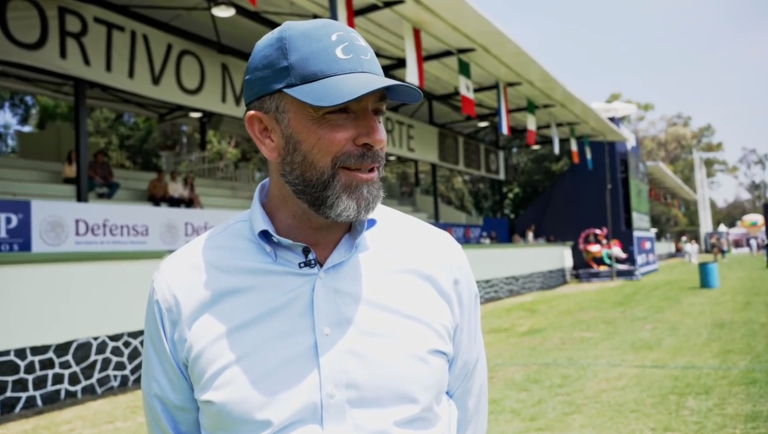
The Longines Global Champions Tour moves at a relentless pace. Cities shift, surfaces change, and the demands on both horse and rider evolve from week to week. But behind every class, every Grand Prix, and every moment of pressure, there is another layer shaping the sport – the course designer.
For Peter Grant, the 2026 season has already delivered a snapshot of everything that defines the tour. From building in Miami Beach, to stepping into the role of assistant to Anderson Lima in Mexico City, and now taking the lead again in Shanghai, his recent run of events reflects not only the intensity of the calendar, but the precision and adaptability required at the very highest level of show jumping.
“It’s part of the job,” Grant says of the pace. “You learn to manage your time, manage your sleep. But building on this circuit, with these riders and horses, it’s always a privilege. The adrenaline helps.”
That rhythm – of movement, adjustment, and constant recalibration – sits at the heart of his role. No two venues are the same, and on a global tour, the contrast is not incremental, it is extreme.
Miami Beach, the season opener, presents a uniquely compact arena framed by one of the most visually striking backdrops in the sport. The proximity of the ocean, the movement of the waves, the atmosphere of the crowd – all of it feeds into how a course must be built.
“There’s no other arena like it,” Grant explains. “You have the visual stimulation of the beach, the ocean, the waves. So you have to approach it in a very specific way – understand what kind of sport you’re going to get there.”
From there, the tour moves to Mexico City, where the vast grass arena at Campo Marte offers an entirely different test. Space opens up. Strides lengthen. The questions change.
“In Mexico, with that big field, you can ask for more scope. It becomes more about galloping, less about carefulness in the same way.”
And then comes Shanghai – a venue that sits somewhere in between. A balance of scale and technicality that mirrors what the sport increasingly looks like across the tour.
“We go from small, to big, to something more standard. And the sport changes within that. How careful you can be, what you can ask of the horses – it all evolves.”
It is this constant variation that defines the challenge. While riders must adapt in the saddle, course designers must anticipate those adaptations before a single horse enters the ring. Every distance, every line, every decision is shaped by an understanding of how horses and riders are likely to respond – not just in isolation, but in the context of the wider tour.
In Mexico City, Grant stepped into a different role, working alongside Anderson Lima rather than leading the build. It is a partnership rooted in decades of shared experience.
“We’ve worked together for 20 years,” Grant says. “We came up together, assisting other designers. We have the same philosophy, but we also understand where we differ.”
That understanding allows for a fluid dynamic. Rather than imposing a singular vision, Grant’s role becomes one of refinement and support – an additional perspective in a process where detail is everything.
“It’s about being an extra set of eyes. Bringing forward what we saw in Miami, how the horses were jumping, the experience we had just a few weeks ago, and helping shape the course from there.”
Beyond the technical demands, Grant is clear about what makes the Longines Global Champions Tour unique. It is not simply the level of sport, but the scale and reach of the platform itself.
“In today’s world, people talk a lot about marketing. But this tour really is global in every sense,” he says. “It’s not just that we travel the world – it’s the impact it has had on the sport.”
From its inception, the tour has played a defining role in expanding show jumping into new regions, particularly across Asia, while maintaining its presence in some of the most iconic venues in the world. That combination has not only elevated the sport, but broadened its audience.
“You have riders from every continent. You have events in places that bring in people who might never have experienced the sport before. It’s global in every possible way – the name couldn’t be more fitting.”
As the 2026 season continues to unfold in this landmark year – celebrating two decades of the Longines Global Champions Tour and ten years of GCL – it is this blend of elite sport and global reach that continues to define its identity.
And for those shaping the courses, like Peter Grant, it is a challenge that goes far beyond building fences. It is about reading the sport, understanding its evolution, and translating that into a test that reflects not just a single venue, but the ever-changing landscape of show jumping at the highest level.
Watch the full interview with Peter Grant to gain further insight into the craft behind course design on the Longines Global Champions Tour.
My vision is clear. Only the best for the best.